DSIP peptide benefits
Sleep has some human evidence. The more dramatic recovery findings belong to animal experiments.
Does DSIP peptide work?
For sleep, the answer remains tentative. The 1981 trial in six middle-aged people with chronic insomnia reported longer sleep, fewer interruptions, slightly more REM sleep and no daytime sedation. A good night followed by a useful day strikes me as the right ambition for an insomnia experiment.
The small scale limits how much confidence the finding can carry. The 2006 review judged the wider sleep evidence weak and poorly documented, with altered versions of DSIP often providing the clearest effects. The human work has yet to mature into a dependable treatment result.
My assessment is cautiously interested in the experiment and unconvinced by a broad promise of better sleep. The research page has the timing detail that makes the trial especially unusual.
Stroke recovery in rats
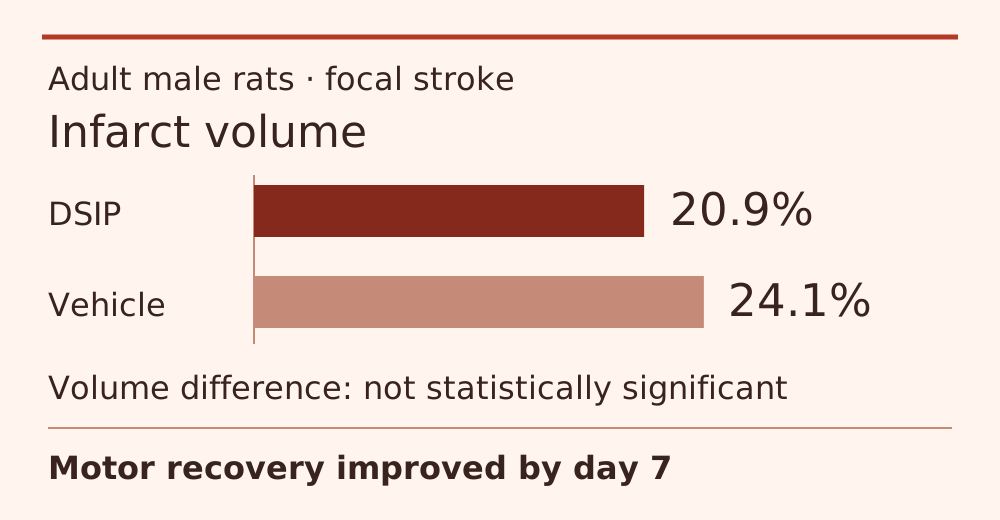
The 2021 focal-stroke study in adult male Sprague-Dawley rats gave DSIP intranasally. Motor recovery improved by day 7. Infarct volume was 20.9% with DSIP and 24.1% with vehicle, the comparison preparation; that difference was not statistically significant.
I expected a clear reduction in injury to accompany better movement. This experiment separated the outcomes. The authors proposed a protective effect on function, while the tissue-volume measurement offered much less support for a claim about reducing the lesion.
That makes a worthwhile animal lead, in my opinion. There is no human stroke trial establishing the same benefit. A separate study of the DSIP-like KND peptide found reduced brain infarction in mice and reduced myocardial infarction in rats during reperfusion, when blood flow returned. KND was the substance tested there; that result cannot establish the effect of DSIP itself.
Seizures and low oxygen
In rats with metaphit-induced epilepsy, DSIP reduced seizure incidence and duration and increased delta-wave EEG power. Another rat experiment under low oxygen found protection of mitochondrial respiration and better coupling of energy production. Mitochondria are the structures within cells that generate usable energy.
From the low-oxygen experiment, my question is quite specific: which part of cellular energy handling changes under stress? A related rat study of DSIP and analogues found that several altered forms counteracted changes in a brain enzyme and serotonin more strongly than the native peptide.
These were animal findings. They establish neither seizure treatment nor recovery benefits in people.
Stress and longevity claims
In a human hormone experiment, intravenous DSIP reduced ACTH-like immunoreactivity for at least 3 hours, while cortisol remained unaffected. ACTH is a pituitary hormone that signals the adrenal glands. A laboratory hormone change supplies little information about whether someone felt calmer, and the broader human hormone literature has been inconsistent.
The longevity claim comes from female SHR mice given a DSIP-containing preparation. Maximum lifespan increased by 24.1%, lifespan among the last 10% of survivors increased by 17.1%, spontaneous tumour incidence fell 2.6-fold and bone-marrow chromosome aberrations fell 22.6%. Those figures concern a preparation containing DSIP and a particular mouse population. Much of this work comes from related research groups, leaving independent replication outstanding.
I put those results in the category of experiments worth following. Promoting them into established human anti-aging benefits would go well beyond the record. Reports of better recovery after hard training are anecdotal accounts, without clinical evidence of a recovery effect beyond the sleep changes people describe.